Recently, a small team of us made our way along Jamaica’s battered north coast toward Hanover, on the northwestern tip of the island. Along the coast from St. Ann through Trelawny and into Montego Bay, St. James, the scars of Hurricane Melissa were painfully visible – trees uprooted, zinc sheets twisted into mangled sculptures, rooftops covered entirely in blue tarp, and houses standing half-exposed to the elements. As we moved westward, the devastation worsened. Familiar landmarks were damaged or gone. Trees stripped bare of their lush coverings left iconic natural landscapes, such as the canopied stretch before the Tryall Golf Course, open to the harsh sun. Hotels once tucked away behind natural privacy screens of dense vegetation were now fully visible from the main road.
In Hanover, our colleague – herself from that parish – helped us make sense of what we were seeing. She reminded us that long before Melissa, Lucea and surrounding communities were already struggling. She described Hanover as “the forgotten parish” – where development has been uneven and public infrastructure barely maintained. The centre of the town itself stood in stark contrast to the perfectly maintained private properties that line the coast.
Our first stop was a small coastal community, Lances Bay, where we met a family of women spanning three generations: a mother battling cancer, her four daughters, and their elderly, ailing grandmother. The cramped house where they lived had lost its roof during the storm, forcing them to evacuate and seek shelter next door at an aunt’s home, waiting out the relentless winds and rain. Since then, they’ve patched together sections of the roof with whatever zinc they could find.
When we arrived, a young woman was washing clothes in a small stream that empties into the sea, right beneath the house. She told us that running water hasn’t reached their pipes in 18 years. The family, like many others in the area, survives on rainwater — and only occasionally receives free water deliveries “when politics time come,” as she put it. Community members lament the diversion of water that once supplied their community to large foreign-owned hotels, forcing them to now buy this critical commodity. They remind us that they have been without water long before Hurricane Melissa came.

Inside, the mother’s quiet strength filled the room. Once a teacher for 15 years, she fell ill last year and has been unable to work since. Her savings were depleted – only two weeks after the storm – by medical expenses. Now, she relies on relatives and occasional help from neighbours to care for her children and elderly mother. The hurricane didn’t just take pieces of their roof, it stripped away what little stability they had left. “All di money inna mi account done,” she said.
This story is one among many. Across Hanover, we saw homes collapsed into piles of tiles and wood – the only remains of lives built with immense effort and sacrifice. Further inland in the community of Blenheim, birthplace of Jamaica’s national hero Alexander Bustamante, the hillsides were littered with debris: clothes, broken appliances, sheets of zinc scattered like confetti. In some yards, only the floorboards remained in the spot where homes once stood.
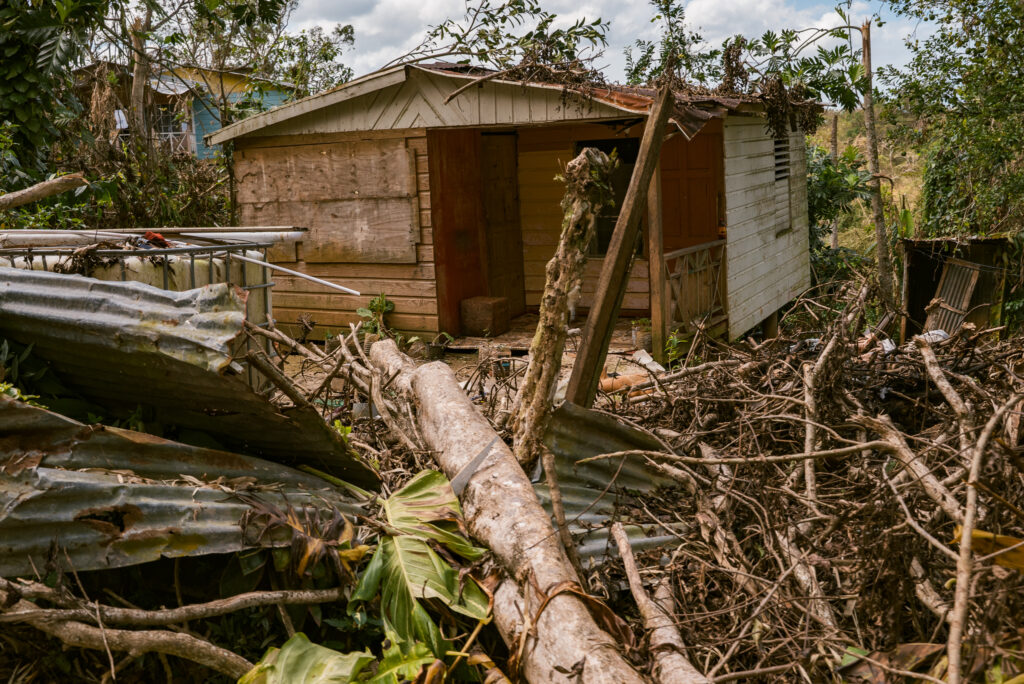
Everywhere we turned, the intersections of poverty and disaster were painfully clear. People here were living in precarity long before Hurricane Melissa. Years of economic hardship, limited access to social services, and fragile infrastructure meant that when the storm came, it struck not just homes but lives already on edge, heavily dependent on tourism – an industry that has served as a further source of disenfranchisement rather than economic empowerment. The meagre wages paid to those hired by the hotels are insufficient to afford them a decent standard of living.
Women, as always, are carrying the weight of recovery – managing households, caring for children, and trying to pick up the pieces, using material recovered from houses destroyed by the storm to rebuild their homes and lives.
Poverty is not just a static condition; it is a multiplier of risk. It determines the quality of the homes people live in, their capacity to save, and the speed at which they can recover after a disaster. Hurricane Melissa has laid bare these inequities – revealing how climate events compound long-standing social and economic vulnerabilities.
In Hanover, resilience is not a choice but a daily act of survival. Families like the ones we met continue to push forward – rebuilding in small ways, caring for each other, holding on to hope. But what they need most is not charity – it’s justice: investment in safe housing, reliable water, healthcare, and livelihoods that can withstand the next storm.
Until those foundations are laid, every hurricane will not just be a natural disaster – it will be a social one.