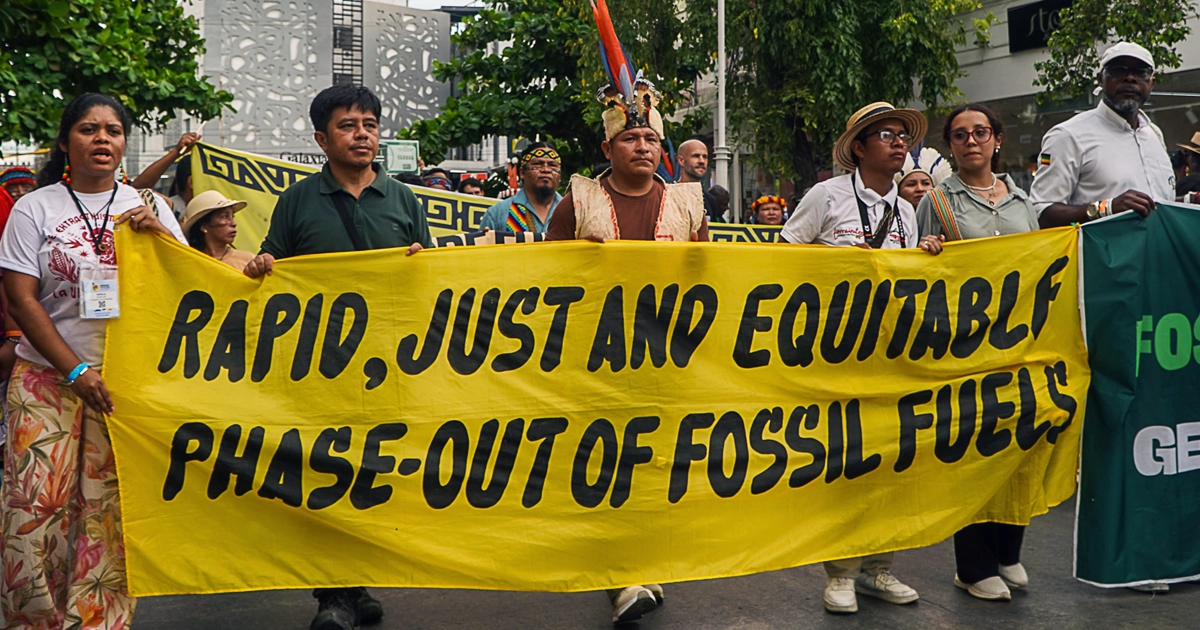
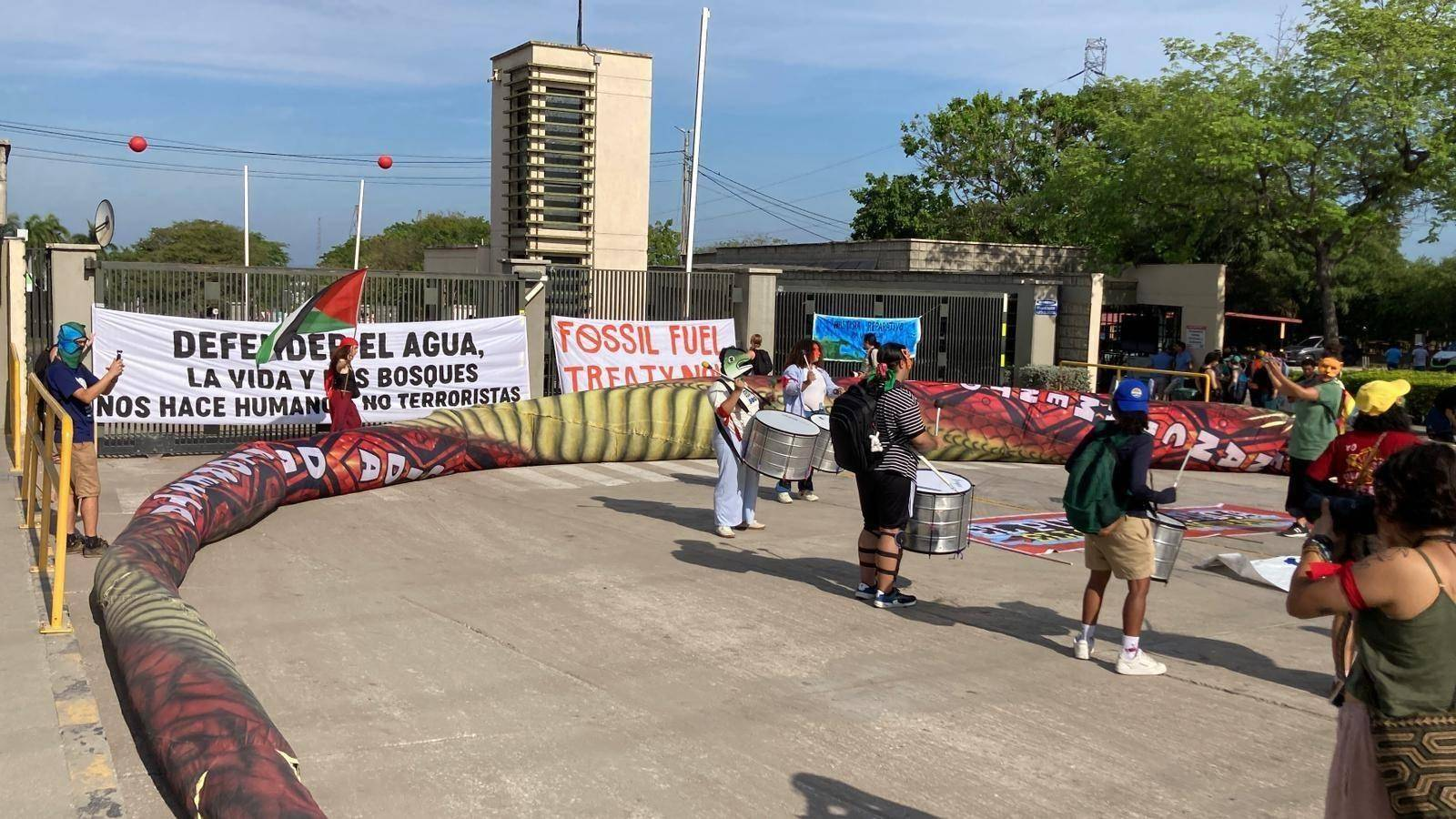
Activists, workers, and local defenders blocked the entrance of the biggest Colombian coal port in Ciénaga on April 27th, 2026. With the slogan “They profit, we Pay”, they denounce the damages of the company activities both on the local community and the complicity of the fossil fuel industry in genocide and ecocide globally.
Protesters carried animal masks and a big snake: a symbol of nature defending itself and of a common struggle to protect and enhance life.
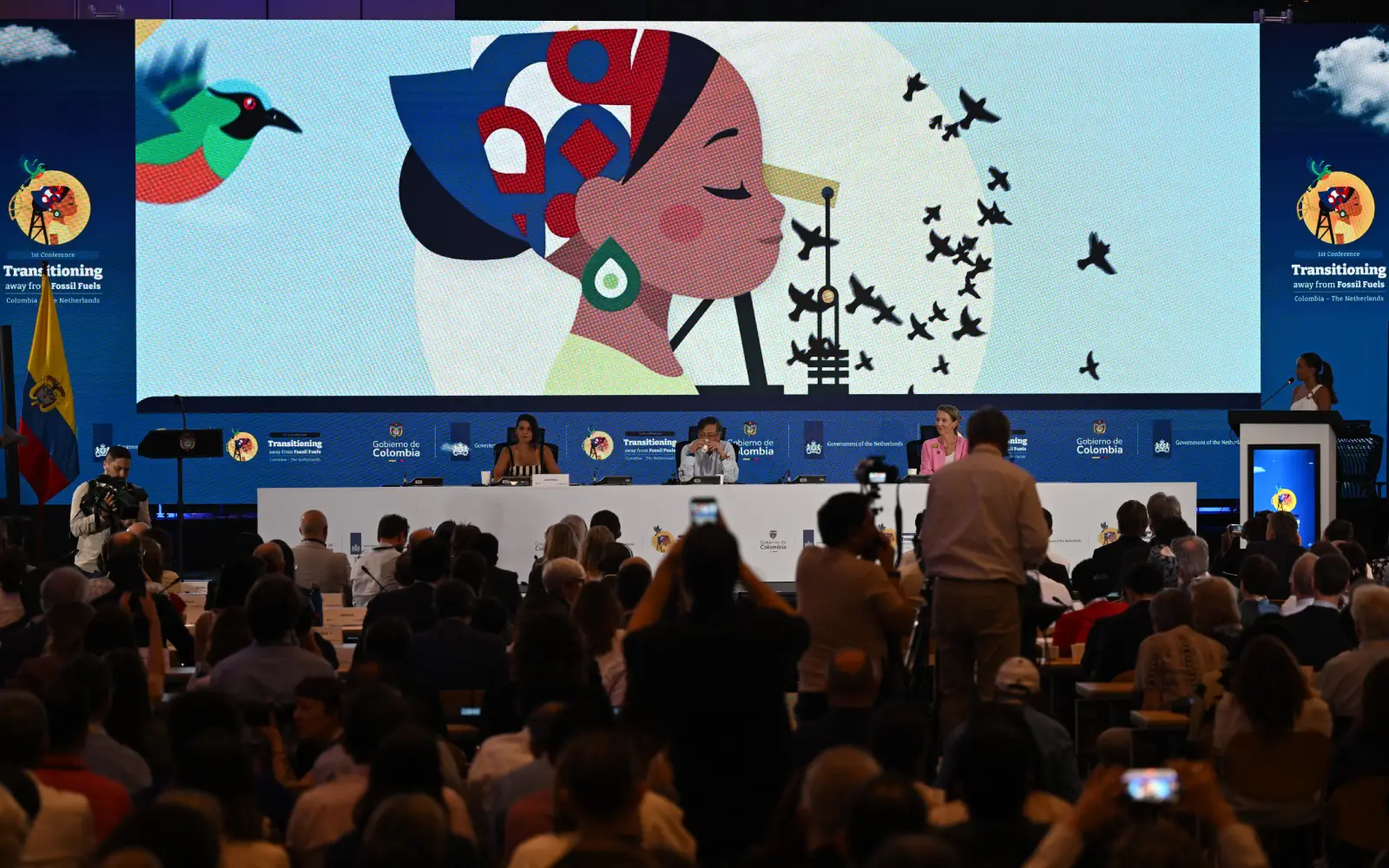
The action was carried out by Global Sumud Flotilla, Climate Justice Flotilla, Debt For Climate, 350, ANGRY, United For Climate Justice, GARN, Resiste Glencore, and regional frontline communities and workers. It took place alongside the First International Conference on Transitioning Away from Fossil Fuels, which convened in Santa Marta last week, where delegates from more than 50 countries prepared for the high-level segment from April 28 to 29.
This protest came as a prelude to the press conference being held that day at Casa de La Memoria, Santa Marta, Colombia. The direct action demands an energy embargo on fossil fuel flows that materially sustain genocide, war crimes, and colonial occupation, and a just transition for local communities, supported by an international transition framework rooted in justice and accountability.
Fossil Fuels Sustain War
This historic First Santa Marta Conference was brought together in a reality where fossil fuels are not only an emissions-based issue. They are very clearly the materials used at the foundation of war. From Venezuela to Cuba, from Palestine to Iran, the US-Israeli alliance and its partners continue to commit war crimes, crimes against humanity, genocide, and ecocide in pursuit of fossil fuel control. This undoubtedly actively blocks energy supplies to those who refuse to comply with its designs.
Any transition roadmap that can’t highlight this blatant fact will inevitably fail the people who depend on it most.
Climate governance as we presently know it regulates emissions — not complicity. It does not regulate the production, trade, insurance, refining, and supply chains that continue to funnel fossil fuels to genocide, colonial war, and military occupation. Trade and investment regimes ensure the protection of fossil capital but do nothing to stop fossil fuel complicity in grave violations of international law. These regimes shield capital. Currently, there exists no climate system that enforces states’ obligations under international law to prevent their exports from enabling mass brutalities and war crimes.
Colombia Sparks Possibility
Colombia’s move to halt coal exports to Israel has established an indispensable precedent: fossil fuel trade is not neutral, and states can act to prevent their energy exports from materially sustaining mass violence. Yet, a global enforcement architecture is needed to ensure policies translate into reality.
A precedent without enforcement is a gesture. There needs to be pressure. As the case in Türkiye shows – where a declared embargo has not halted crude oil flows through its territory – the gap between political will and enforcement is where the fossil fuel industry operates freely. Building the architecture that closes that gap, including supply-chain transparency, anti-circumvention measures, and binding conditionality, is the work this conference began.
There is no credible global climate action without confronting the fossil fuel supply chains that enable genocide and ecocide. There is no climate transition without global justice.
From every river to every sea, the profit chains fueling mass violence must be disrupted, exposed, and phased out. The Santa Marta Conference offered a decisive opening to shift from rhetoric to enforcement.
Colombia’s courage and its leadership are recognised. The Global North countries sre being called on to match it: assume their historical responsibilities, accelerate their own phase-out commitments, and pay for the transition they have deferred for decades. More than this, we plead that our Caribbean leaders get on board.
What are the demands?
- Make an energy embargo a central political question of this conference. States must be pressed to cease fossil fuel transfers that materially sustain genocide, war crimes, illegal occupation, or other grave violations of international humanitarian law. Energy embargoes are not exceptional gestures. They are instruments of ending complicity in grave human rights violations.
- Build the enforcement architecture that makes embargoes real. Mandate a global supply-chain transparency instrument with public shipment tracking, end-destination disclosure, and anti-circumvention measures covering ship-to-ship transfers, AIS (Automatic Identification System) manipulation, intermediary refining, and opaque trader structures.
- The demand for protection for workers and unions as frontline actors in just transition enforcement. Those who refuse to load, refine, transport, or insure fossil fuel cargoes linked to atrocity crimes must be protected from dismissal, prosecution, and retaliation.
- Recognise energy sovereignty as a foundational principle of just transition. Colonised and occupied peoples must have the right to control their own energy resources and systems. A fossil fuel treaty without this principle will reproduce the hierarchies that built the fossil economy.
- Give communities legal standing to refuse extraction and trigger accountability. Free, prior and informed consent cannot remain a procedural fiction. Communities must be able to contest extraction, withdraw consent, and activate binding obligations on states and corporations.
- Open a pathway toward a binding Fossil Fuel Non-Proliferation Treaty that addresses production, trade, supply chains, and fossil fuel complicity in atrocity crimes. It must include energy sovereignty, supply-chain transparency, worker protection, and international-law conditionality in climate and reconstruction finance. The treaty must also establish reparative finance obligations on states and corporations whose fossil fuel production and trade have materially sustained conflict, international crimes, and ecological destruction.
It is no secret that the fossil fuel economy was built through colonial extraction, unequal exchange, and organised violence. Major states and corporations built it together, and they sustain it together.
There is no just transition without decolonisation.