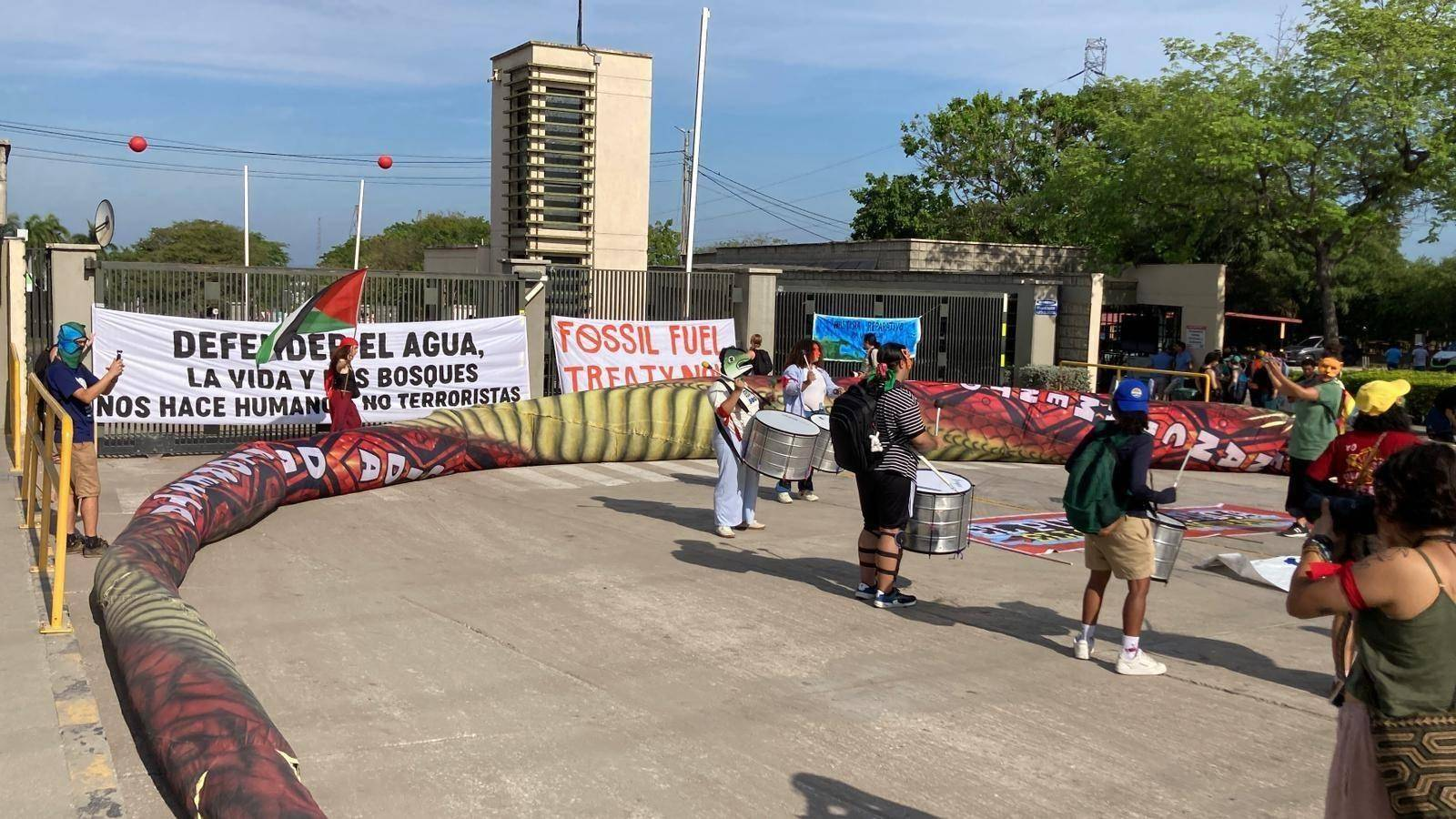
At the historic First Conference on Transitioning Away from Fossil Fuels, held in Santa Marta, Colombia, France announced a comprehensive national roadmap to transition away from fossil fuels on April 28th, 2026.
In addition to formalising domestic targets, the roadmap outlines France’s commitments to international support, detailing how the government plans to finance and assist global efforts in the broader energy transition. It highlights France’s commitment to ending its reliance on fossil fuels, with specific targets to phase out coal by 2030, oil by 2045, and natural gas by 2050.
Benoît Faraco, France’s Special Envoy for Climate Negotiations, made mention of the roadmap in his intervention at the opening plenary on Tuesday. He stated, “We are also very proud to be one of the first countries to publish a domestic roadmap to transition away from fossil fuels. It was a top priority for my Minister to prepare it and to present it here in Santa Marta.”
The First Conference on Transitioning Away from Fossil Fuels took place from April 24 to 29, where countries agreed to accelerate international cooperation on transitioning away from fossil fuels by coordinating on comprehensive national and regional roadmaps, aligning cross-border trade policies to build green sectors, and unlocking solutions to systemic finance traps.
The current and incoming co-chairs are committed to helping countries navigate ongoing processes led by the United Nations, national climate plans, the transition away from fossil fuels conferences, and country-led initiatives. This conference, which was co-hosted by Colombia and the Netherlands, comes at an especially distinctive time when governments continue to deal with the impacts of the worst energy crisis ever.
On 27 April 2026, Tuvalu and Ireland announced that they will co-host the next transitioning away from fossil fuels conference in 2027 in Tuvalu — a year away from now.
During leader speeches in the High Level segment, a host of countries doubled down on the need to accelerate the deployment of renewable energy, setting out the economic and security benefits.
Rachel Kyte, UK Special Representative on Climate, reminded us, “The origin story of this conference is in our steady but outpaced progress we’ve been making in climate negotiations over many years. But we now meet at a critical time—it would be irresponsible to ignore the second fossil fuel crisis in five years.”
Similarly, Ana Toni, COP30 CEO said: “Perhaps even the skeptical ones at COP30 have by now, with the war against Iran by the US and Israel, come to realise that a fast implementation of the agreed transition away from fossil fuel is not just vital to combat climate change, but is also vital for energy security, for energy sovereignty, for economic security, for economic fairness, for justice and especially for peace.”
Colombia’s Roadmap Parallel
On May 17, 2024, Colombia announced its own Just Energy Transition Roadmap, which aimed at transforming the country’s energy system towards cleaner sources while ensuring social equity and territorial development. The roadmap outlines goals for increasing renewable energy capacity, phasing out fossil fuels, democratising energy systems, and creating job opportunities in the clean energy sector. Most notably, it stated the ambitious target of achieving 50% of the country’s energy supply from renewable sources by 2030.
So how is France’s roadmap any different?
France released a concrete, timeline-driven national roadmap to phase out fossil fuel consumption by 2050, focusing on coal (2030), oil (2045), and gas (2050). Colombia, however, is creating a regional and national strategy focused on production transition, aiming to cut emissions by 90% by 2050 and diversifying its economy.
France focuses on decreasing consumption and demand, while Colombia focuses on reducing production, supply, and economic diversification. It is noteworthy that France is a high-income nation focusing on ending dependence with concrete deadlines for specific fuels; Colombia is a producer country focusing on transforming its economy, focusing on 2050 goals.
If Colombia executes the framework even partially through 2030, the precedent for Brazil, Mexico, Argentina, and Venezuela becomes more difficult to ignore. Santa Marta — one of the world’s largest coal export ports — chosen as host city was deliberate symbolism.
The Caribbean’s Position
This move encourages the Caribbean to accelerate its own transition to renewable energy, supporting regional goals to reduce reliance on imported fossil fuels, lower energy costs, and decrease climate vulnerability.
The announcement of France’s national roadmap aligns with calls from Caribbean nations for a fair, funded, and managed phase-out of fossil fuels, as reported by the Fossil Fuel Treaty Initiative.
The roadmap offers a model for Caribbean nations to develop their own comprehensive, science-based plans for transitioning toward renewable energy sources. More than this, the focus on moving beyond fossil fuels supports the expansion of the green economy in the Caribbean, particularly through investment in solar and other non-conventional renewables.
This action, coupled with EU support for sustainable energy projects, fits into a broader movement of the 57 countries that gathered in Colombia to accelerate the global shift to clean energy. There needs to be more pressure on our Caribbean governments to move forward.