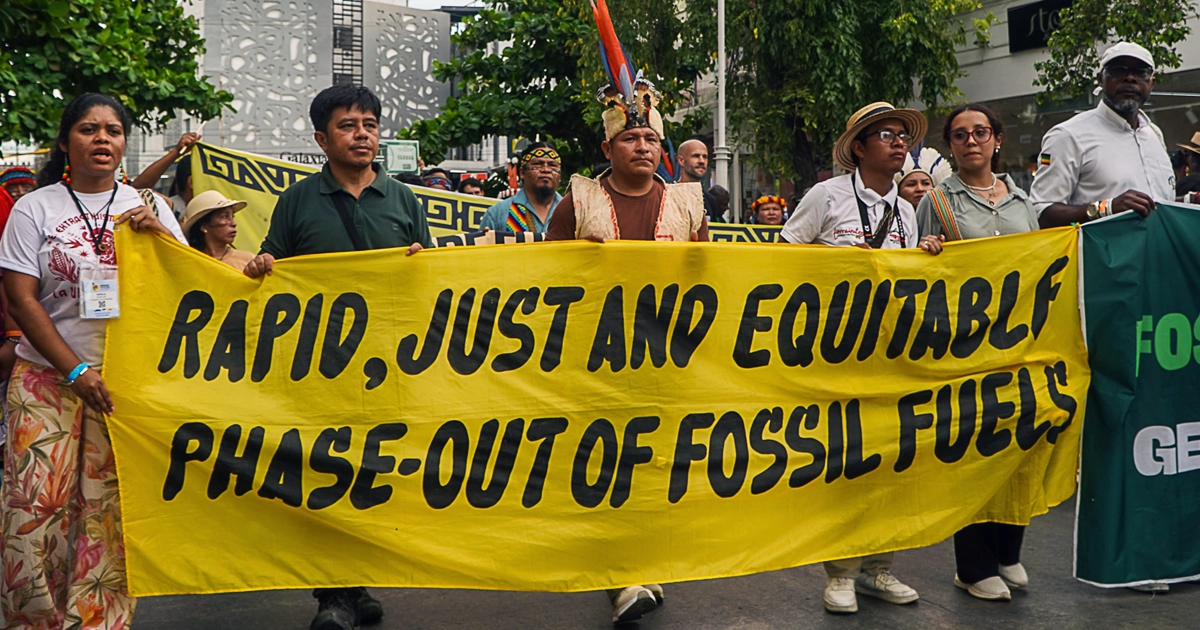
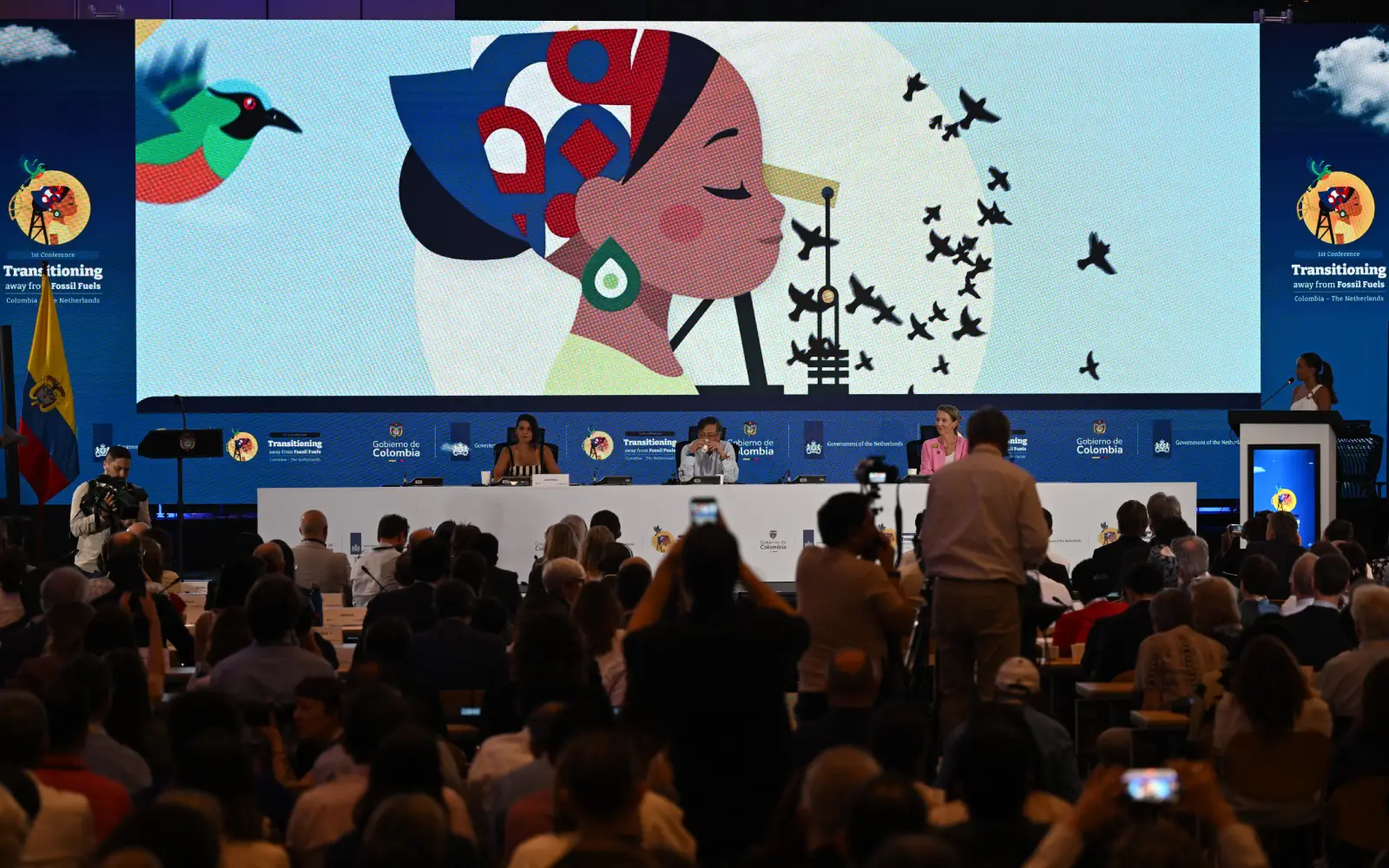
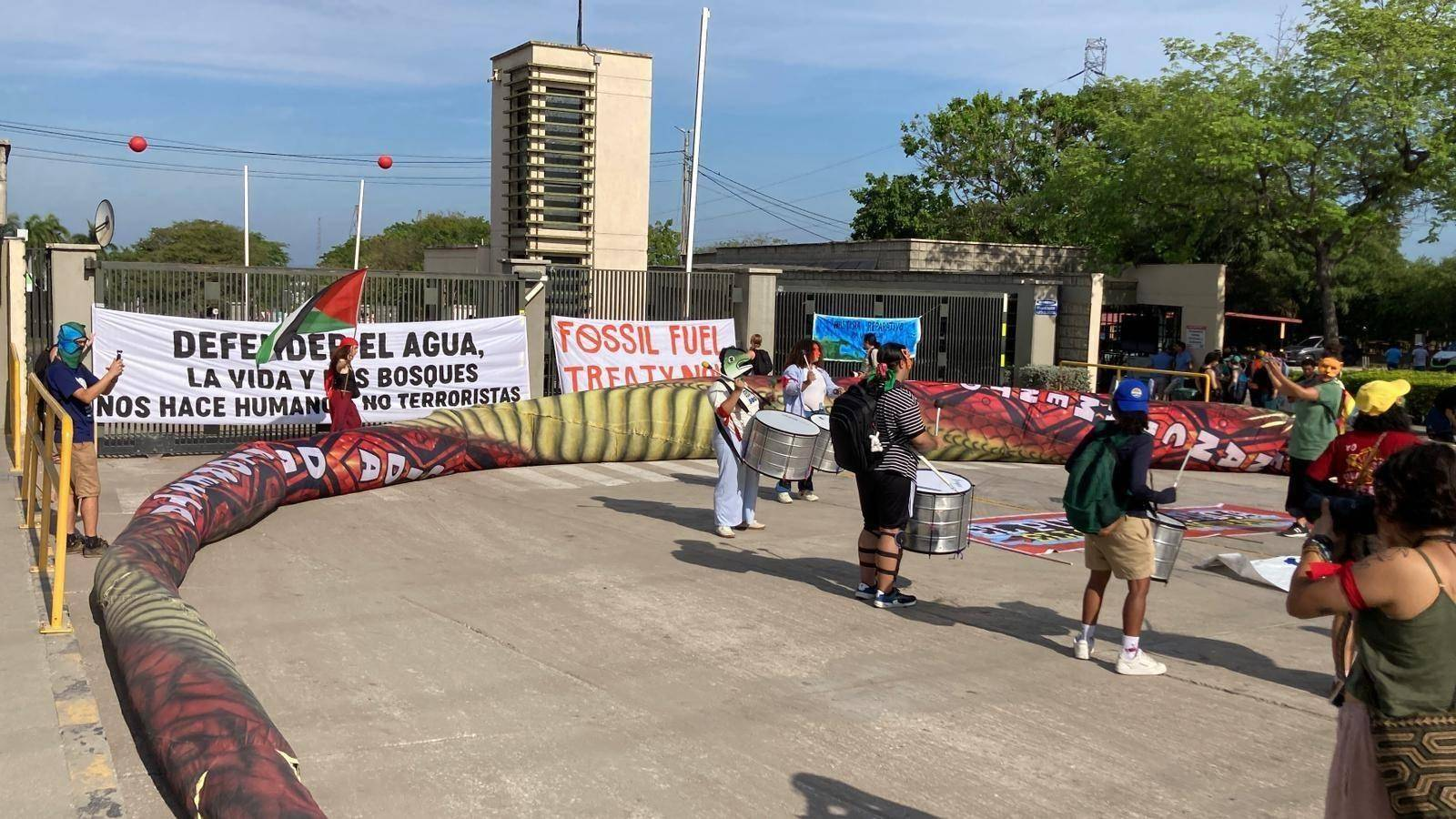
The People’s Summit for a Fossil-Free Future launched its declaration on 26 April 2026 in Santa Marta, Colombia, during the First International Conference on transitioning away from fossil fuels.
More than 50 countries are expected to engage with the process as part of this historic gathering, co-organised by a wide range of actors including the governments of Colombia and the Netherlands, alongside a global coalition of civil society organisations, Caribbean representatives, frontline communities, and others.
On Sunday 26 April 2026, the People’s Declaration for a Rapid, Equitable, and Just Transition for a Fossil-Free Future was officially launched. Rooted in the coal-exporting port city of Santa Marta, the Declaration presents a proposed blueprint for a just transition grounded in human rights, energy democracy, and climate justice.
Why the Declaration Matters
The scientific and legal limit of global warming is 1.5°C. However, current fossil fuel expansion plans would push the world well beyond that threshold, potentially exceeding 3°C of warming, with severe implications for ecosystems and human survival.
The World Meteorological Organisation has projected that global long-term average temperatures will likely exceed 1.5°C for the first time around 2027, significantly earlier than previously estimated by the Intergovernmental Panel on Climate Change (IPCC).
If global CO₂ emissions remain at current levels of roughly 40 billion tonnes per year, the remaining carbon budget of approximately 130 billion tonnes would be exhausted in about three years.
For many countries—particularly low- and middle-income nations such as Trinidad and Tobago, Jamaica, and Guyana—the transition away from fossil fuels is constrained by debt burdens, dependence on extraction industries, and limited fiscal space. The Declaration emphasises the need for fair timelines, financing, and international support to manage this transition.
At present, there is no global mechanism specifically designed to govern a fair, coordinated phaseout of fossil fuels. The Declaration seeks to help define what such a roadmap could look like.
Key Highlights of the Declaration
The Declaration was developed over months of collective dialogue, bringing together diverse global demands into a unified vision. It asserts that the era of negotiation must give way to the era of implementation.
It frames the climate crisis as a consequence of global systems rooted in capitalism, colonialism, and militarism, and links fossil fuel dependence to broader patterns of geopolitical violence. It also calls on governments to recognise the ecological debt owed by the Global North to the Global South.
The coalition further calls for an upcoming “coalition of the willing” to commit to binding mechanisms for a fast, fair, and funded fossil fuel phaseout. This includes rejecting false solutions and providing unconditional, non-debt-creating public finance alongside reparations necessary for both communities and ecological survival.
The 15 Principles
The Declaration outlines 15 guiding principles:
Principle 1: Rapid, transformative, and science-based, while drawing from ancestral and popular knowledge and wisdom.
Principle 2: Fair and equitable, based on historical and continuing responsibility.
Principle 3: Addressing energy poverty and the universal right to gender-just, non-racist, and equitable access to sufficient sustainable energy.
Principle 4: Efficiency, sufficiency, sovereignty, and responsible use.
Principle 5: Energy democracy and sovereignty.
Principle 6: People(s)-centred human rights, justice, and inclusion, especially of workers, women, migrants, Indigenous Peoples, Afro-descendants, youth, and marginalised communities and territories.
Principle 7: Democratic and sustainable governance of land, water, ocean, and natural resources.
Principle 8: Sustainable and equitable management of transition minerals.
Principle 9: Ecological justice, integrity, and regeneration.
Principle 10: Mobilising adequate and just finance and removing financial and fiscal barriers.
Principle 11: No false solutions.
Principle 12: Sovereignty, peace, and global justice.
Principle 13: Reparative and transformative justice.
Principle 14: International solidarity and cooperation.
Principle 15: System change.
The Declaration is explicit in its call for structural transformation, rejecting incrementalism:
“Solutions to the climate crisis require more than incremental change…We need to build new systems and relationships that are not capitalist, patriarchal, racist, extractivist, supremacist and hegemonic.”
Core Demands
The Declaration outlines several major demands:
1. End fossil fuel expansion
An immediate halt to all expansion of the fossil fuel industry, including exploration, extraction, production, and distribution.
2. Universal access to clean energy
A rapid, equitable, and rights-based expansion of renewable energy systems to ensure universal access, with a strong emphasis on participation and justice.
3. Reform climate finance
The Declaration stresses that climate finance from wealthy nations is not charity but a legal and moral obligation rooted in historical emissions and extraction.
4. Fossil fuel phaseout linked to peace and security
It connects fossil fuel dependence to militarism and global conflict, noting that in 2024 global military spending reached US$2.7 trillion, which it argues should instead support renewable energy and climate adaptation.
What Comes Next
The formal conference concluded on 29 April 2026. Government representatives, scientists, civil society organisations, and activists contributed to discussions throughout the event.
The coalition behind the People’s Declaration has committed to sustaining momentum through a global campaign called “Fossil Free Rising”, which will include coordinated days of action and continued mobilisation.
The summit was widely described by participants as a historic moment, marking one of the closest points yet to a coherent global roadmap for a fossil-free future.
Read full declaration here:
PEOPLE’S DECLARATION FOR A RAPID, EQUITABLE, AND JUST TRANSITION for a FOSSIL-FREE FUTURE